
SOBRE NÓS
A Yantai Yunde Intelligent Technology Co., Ltd. possui apenas 30 anos de experiência em produção, atendeu mais de 300 clientes nacionais e estrangeiros e produziu mais de 2.000 máquinas.
SOLICITE UM ORÇAMENTO GRÁTIS
-
Lar

-
Blog
-
Blogs do setor
- Bar Straightening for Precision Component Manufacturing
Bar Straightening for Precision Component Manufacturing
-
 autor
autor - 17,Setembro
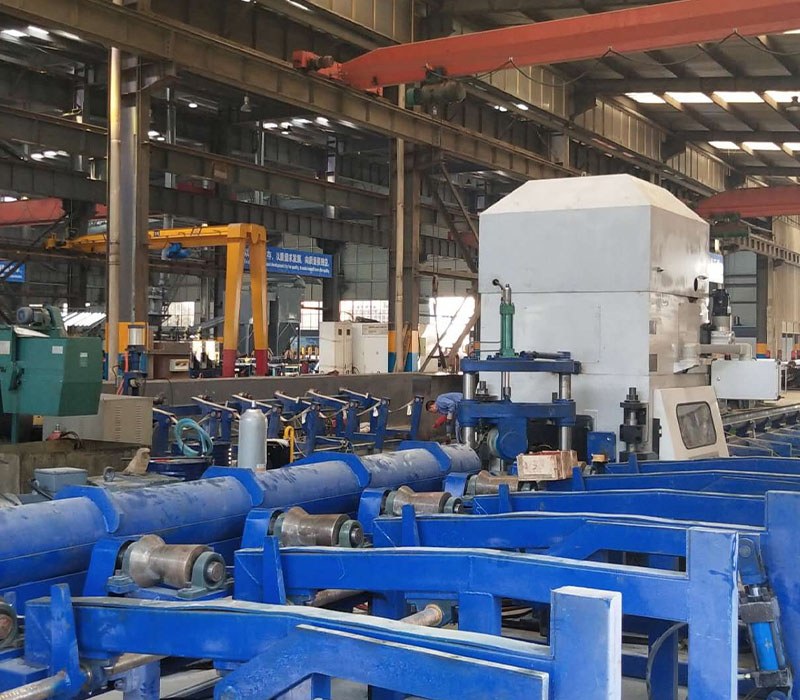
A bright round bar can have the right diameter and still cause trouble during machining. Bow changes how the stock sits, feeds and rotates. For processors supplying precision component manufacturers, straightening improves the geometry of the machining blank. Its value depends on how straightness, surface condition and material response relate to the next operation.
Why straightness matters before the first cut
Straightness describes the departure of a bar from a straight reference over a defined length. Diameter describes its cross-sectional size. A satisfactory diameter measurement therefore cannot establish whether a long bar is straight enough for its intended operation.
A bowed bar also leaves uneven material around the intended machining axis. Correcting that bow can make the available machining allowance more consistent. It does not create extra stock, repair internal defects or establish the final component’s dimensional tolerance.
Precision shafts make the distinction practical. A processor needs to supply stock that the component manufacturer can support and locate consistently. The customer’s drawing and process determine the required condition; a general description such as “precision bar” leaves too much unresolved.
This is the role of a round bar straightening machine in professional bar production: improving the geometry of the incoming blank before downstream operations have to accommodate it. Understanding how the correction happens explains why material and machine settings matter together.
How two rolls correct a curved bar
UM two roll straightening machine works through controlled alternating bending and reverse bending as the bar moves through the roll contact region. Part of the deformation must remain after the load is removed. Purely elastic deflection would allow the bar to spring back toward its previous shape.
Roll contour, roll angle, roll gap and straightening speed influence that bending action. The relevant setting depends on the bar diameter and material response. Copying a setup from a different grade can produce a different result even when the nominal diameter is unchanged.
For processors evaluating this method, YUNDE’s BS series provides a frame-type, two-roll configuration for straight bars. Its concave and convex rollers use line contact, while the rigid overall frame helps maintain the roll-gap position. The BS series is the machine family discussed here.
An independent hydraulic system provides pressure holding and load release. These functions support controlled operation, but their presence alone does not establish the result for a particular batch. The useful evidence is the condition of representative bars after processing with the proposed setup.

What BS accuracy figures mean for machining stock
The BS80 provides a concrete example of how several specifications interact. Its processing diameter range is 20–80 mm, with a minimum bar length of 2 m and a listed speed range of 10–24 m/min. A short component blank below that minimum length falls outside this stated processing envelope.
Its listed straightness is 0.25 mm/m. To work together with the Yunde Peeling Machine and straightening machine, we can achieve bright bars with diameter tolerance ≤IT8 and surface roughness Ra≤0.8 μm.
| BS80 quality characteristic | Listed value | Meaning for the processor |
| Retidão | 0,25 mm/m | Relates curvature to a stated length basis. |
| Tolerância de diâmetro | ≤IT8 | A tolerance grade, not a fixed millimetre allowance. |
| rugosidade da superfície | Ra≤0,8 μm | Describes surface texture, not the bar’s longitudinal bow. |
The straightness entry requires a defined inspection method. Agree on the support arrangement, measured length, end treatment and acceptance criterion. Multiplying a per-metre figure by the total bar length does not, by itself, establish an allowable full-length bow or rotational runout.
UM máquina de endireitar barras should therefore be assessed against the drawing’s actual requirements. The BS80 example explains one processing envelope; it does not make that model the right choice for every combination of bar diameter, material strength and finished-component requirements.
Why a straight bar can still distort during machining
Straightening changes the material’s stress distribution as well as its shape. Research on two-roll straightening of 42CrMo bars has identified residual stress after the operation. A straight external profile should therefore never be presented as proof that a bar is free of internal stress.
Removing material during subsequent machining can disturb an existing stress balance. For a slender precision part, the practical question is whether the supplied stock stays sufficiently stable through the customer’s planned process. Straightness at dispatch answers only part of that question.
Representative trials should connect the straightened bar to its next operation. A useful trial records the material grade and condition, incoming curvature, machine setup, outgoing straightness and the result after the intended machining sequence. This ties the evaluation to an identifiable batch rather than a general capability claim.
Handling belongs in that evaluation too. Check bars after they have passed through the intended transfer and storage stages. The máquina de alisar establishes a processing step; the useful supply condition is the one that reaches the component manufacturer.
A clearer basis for precision bar supply
Bar straightening supports precision manufacturing by correcting the stock geometry that machining begins with. The strongest specification combines a defined straightness requirement with diameter, surface roughness and a material-specific trial. For the BS series, keep the selected model’s processing envelope and the customer’s downstream acceptance criteria in the same discussion.

Perguntas frequentes
How does a two-roll machine straighten round bars?
The rolls impose bending and reverse bending through their contact with the moving bar. Controlled permanent deformation reduces the remaining curvature after unloading. Roll geometry and settings influence the result.
Is straightness the same as diameter tolerance?
No. Straightness concerns longitudinal form; diameter tolerance concerns cross-sectional size. A bar can satisfy one requirement while missing the other, so both need separate evaluation.
What straightness is listed for the BS80?
The BS80 has a listed straightness of 0.25 mm/m. Confirm the inspection method, material condition and agreed acceptance criteria before treating that entry as a production commitment.
Does straightening remove all residual stress?
No such conclusion follows from a straightness measurement. Two-roll straightening can leave residual stresses, so demanding precision applications may need trials through the subsequent machining process.
Can the BS80 process short component blanks?
Its stated minimum bar length is 2 m. A shorter blank is outside that listed envelope. Evaluate the appropriate stock-processing stage and model configuration before assuming it can be handled.
Postagem recente





Produtos relacionados
Produtos mais vendidos

Linha de alinhamento de descascamento da bobina à barra
O fio-máquina de aço inoxidável é desenrolado e pré-endireitado, depois desbastado em um torno sem centros e cortado em um comprimento preciso. Após uma passagem final de endireitamento de precisão em uma endireitadeira de dois rolos, o produto resultante é uma barra reta de aço inoxidável de alta precisão.

Máquina de descascar (torno sem centros)
A unidade de descascamento (torno sem centros) é um produto desenvolvido de forma independente após a comparação e o contraste das vantagens de produtos estrangeiros similares, combinando-as com as características de produção das empresas nacionais, resultando em um projeto simplificado e otimizado.

Linha de produção bobina a bobina
A linha de produção bobina a bobina é composta por uma série de máquinas, incluindo desenrolador e endireitador, descascador, mecanismo de fixação, dispositivo de pré-dobra, rebobinador, etc. Através dessas máquinas, a bobina preta é processada em bobina brilhante com boa qualidade de superfície.

Máquina de endireitar série BS
Uma máquina de endireitar é um dispositivo usado para endireitar perfis metálicos, barras, tubos e fios. A máquina de endireitar utiliza rolos de endireitamento para comprimir o material, alterando sua retidão. Geralmente, existem duas fileiras de rolos de endireitamento, com números variáveis de rolos. Existem também máquinas de endireitar com dois rolos, que dependem da mudança de ângulo de dois rolos (com formato côncavo hiperbólico) para endireitar materiais de diferentes diâmetros.

Máquina de endireitamento de tubos de aço com múltiplos rolos
É um dispositivo mecânico usado para corrigir a curvatura e a ovalização de tubos de aço. É utilizado para endireitar tubos feitos de aço e ligas de alta resistência, resistentes à corrosão e ao calor, bem como ligas de ferro-níquel, níquel e titânio, de modo a reduzir a não retilineidade longitudinal e a não circularidade da seção transversal.

Máquina de endireitamento horizontal e vertical
Solte o volante da máquina de endireitar horizontal e vertical de múltiplos rolos para permitir que a bobina de arame passe pelos rolos de endireitamento. Aperte o volante até a posição determinada empiricamente, ligue o dispositivo de alimentação e realize testes de endireitamento repetidos. Em seguida, alimente a bobina de arame nos rolos de endireitamento vertical, seguindo o mesmo procedimento do endireitamento horizontal. Finalmente, alimente a bobina de arame no dispositivo de alimentação da máquina de descascar.


